Care described through touch
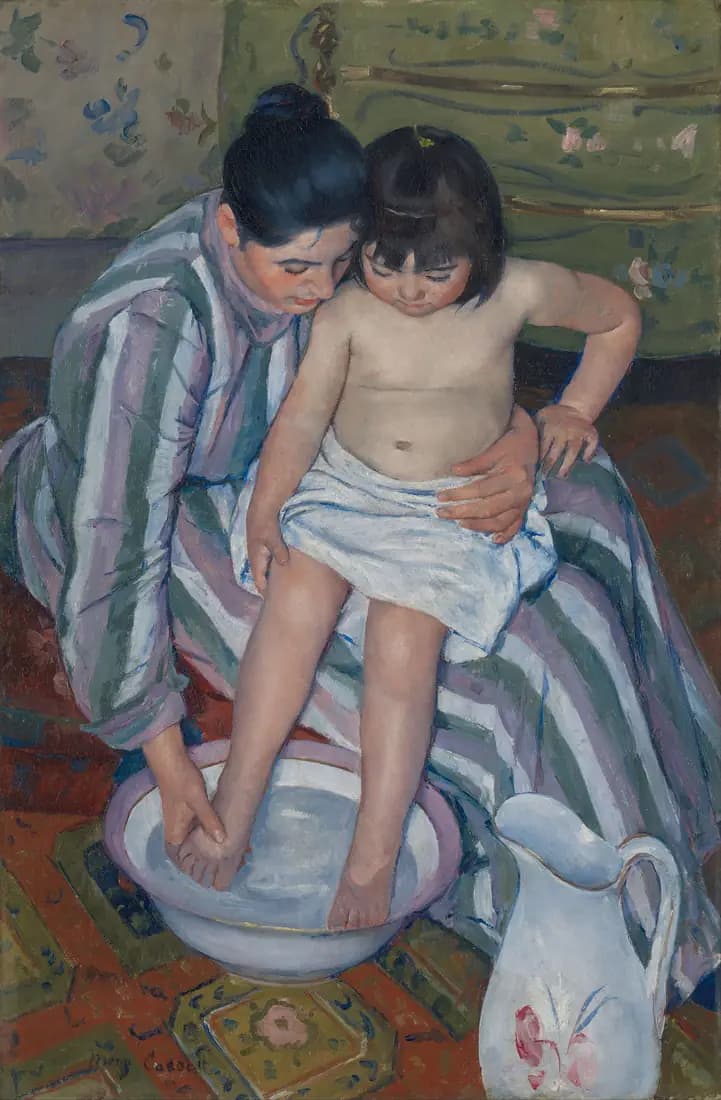
The adult and child do not meet our gaze. Their concentration is physical: hands support, balance and wash. Cassatt avoids a posed sentimental embrace and chooses a practical act requiring trust. The close crop makes the viewer share its intimate distance without interrupting it.
A room tipped toward the surface
The basin appears almost circular, although perspective should make it more elliptical. Floor and furniture rise steeply behind the figures. This flattened space lets patterns remain visible and brings the water, jug and feet close to the picture plane.
Looking at Japanese prints
Cassatt admired Japanese ukiyo-e and made colour prints after seeing a major Paris exhibition in 1890. Their high viewpoints, cropped forms and decorative pattern influenced works including The Child's Bath. She did not simply imitate a style. She used those spatial ideas to give domestic experience a new visual authority and monumentality.
A private ritual seen from above
Cassatt raises the viewpoint so the basin, jug and patterned floor open toward us. The child’s body remains securely enclosed by the adult’s arms and striped dress, creating a circle of touch within the flatter decorative space. We can see the washing clearly without the scene feeling exposed, because both figures concentrate on the same small task.
Japanese prints helped Cassatt rethink cropping, outline and areas of pattern. That influence is visible without reducing the painting to imitation. The tipped perspective makes the basin almost round, the wallpaper and carpet remain assertive, and empty depth matters less than the arrangement of shapes. Modern domestic care becomes a subject large enough for ambitious painting through design as well as tenderness.
Sources and further reading
- Art Institute of Chicago collection recordObject, subject, Japanese influence and technique.
- National Gallery of Art, Mary CassattInstitutional artist context and printmaking practice.