A disguise creates the scene
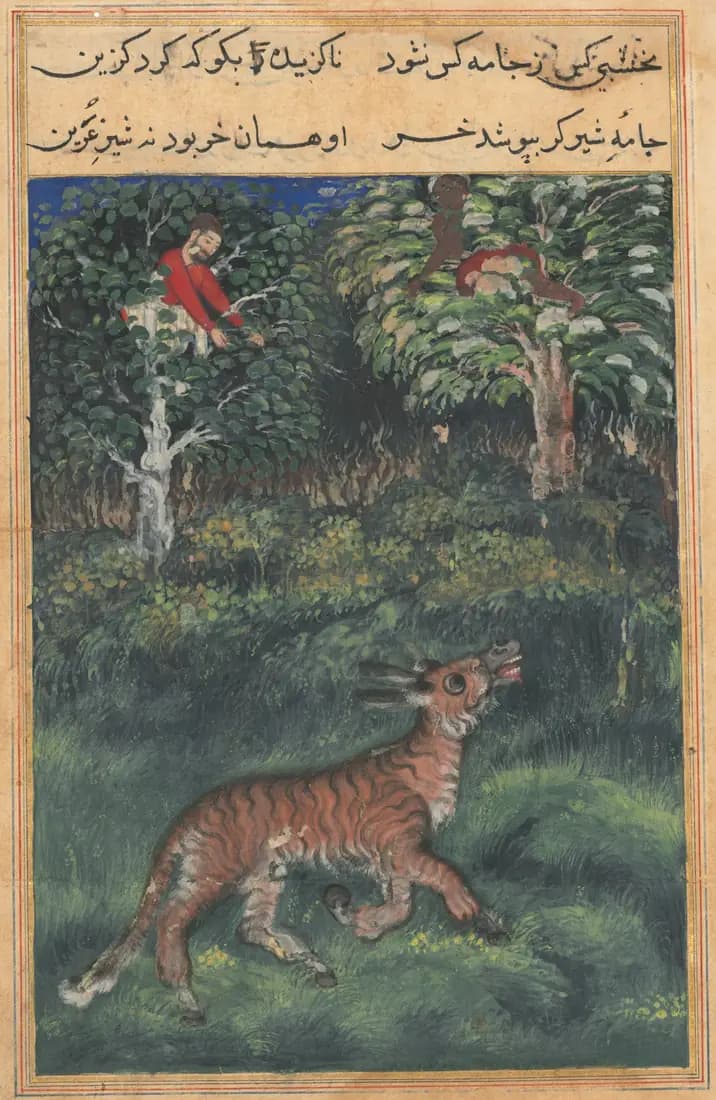
In the fable, a merchant cannot afford enough food for his donkey. He finds a tiger skin and sends the disguised animal into other people's fields, where fear protects it while it grazes. The painting shows the deception at its most successful. The donkey occupies the ground while two watchmen have retreated into trees.
The striped hide is convincing enough at a distance, but the animal's head and legs already complicate the illusion. The viewer is allowed to know more than the figures inside the story.
One sound ends the performance
The title identifies the decisive instant: the disguised donkey hears another donkey and brays back. Its voice reveals what the borrowed appearance concealed. The watchmen can finally recognize the animal that has been eating the crop.
Like many animal fables, the tale makes its lesson portable. Clothing can imitate power, but conduct exposes identity. The humor depends on the sudden reversal: the sound of an ordinary voice undoes an intimidating appearance.
A page carries image and text
The painting belongs to the Tuti-nama, or Tales of a Parrot, a sequence of stories told night after night. Persian text sits above the image, and a gold border holds the miniature inside the manuscript page. Reading and looking would have unfolded together rather than as separate experiences.
The compact format rewards close attention. Fur, grasses, leaves, and rocks are differentiated through dense brushwork, while the steep arrangement lets the eye move quickly between animal and watchmen.
An early work points toward Mughal painting
The attribution to Basavana is based on style rather than a secure signature. The Metropolitan Museum identifies him as a major painter in Emperor Akbar's workshop and notes his participation in the Mughal Tuti-nama during the early 1560s. His later reputation rested on composition, portraiture, color, and increasingly naturalistic landscapes.
This small page stands near the beginning of that career. Its plants and animals do not merely decorate a moral. They create the believable space in which an impossible tiger can briefly exist.
Sources and further reading
- Cleveland Museum of Art collection recordExact folio, full fable, manuscript context, attribution, figures, and brushwork.
- Metropolitan Museum of Art, Wonder of the AgeBasavana's role in Akbar's atelier, early Tuti-nama work, style, and later importance.