Three gestures repeated
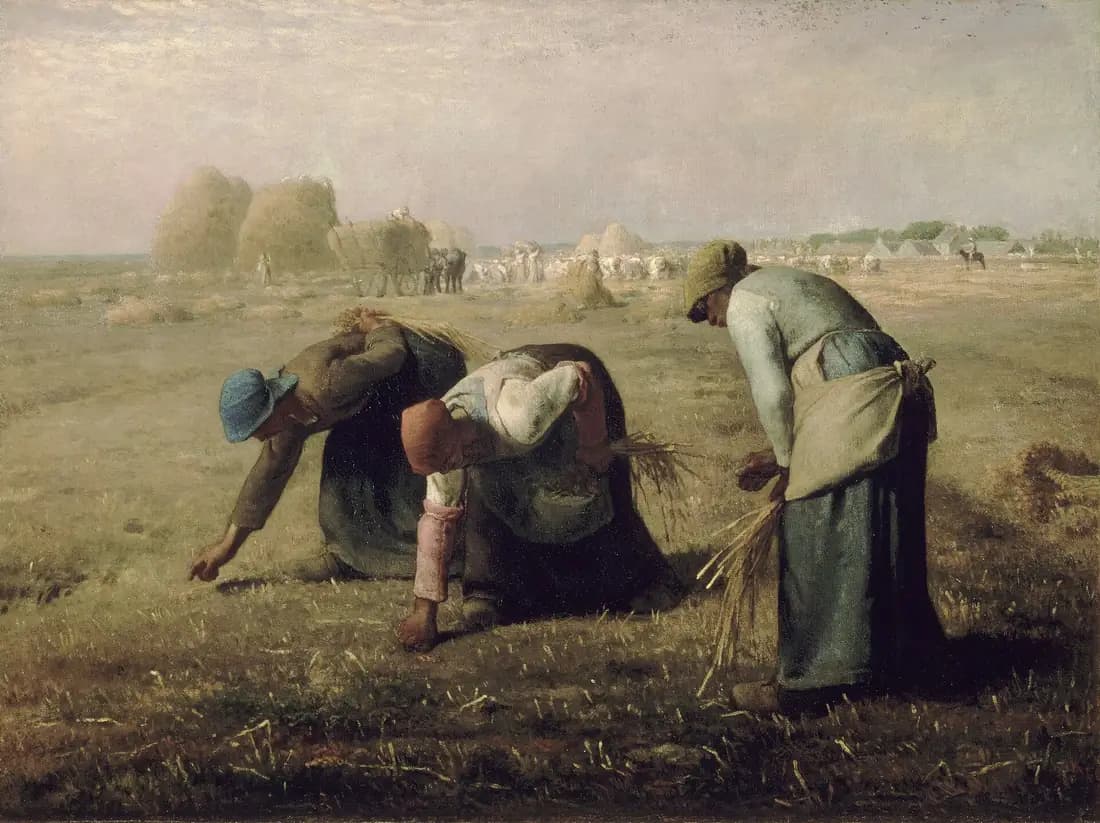
Each woman performs a different moment of the same exhausting action: searching, grasping and beginning to rise. Their bodies create a slow sequence across the field. Faces remain largely hidden, so posture and hands carry the weight of work. The low viewpoint makes the figures feel solid against the bright horizon.
Abundance placed far away
Behind them, sheaves, haystacks, carts and many labourers fill the estate. A mounted overseer watches at the right. Millet separates the gleaners from this wealth through scale and distance. They collect what remains after the principal harvest has been claimed.
Why the painting disturbed viewers
The memory of the 1848 Revolution was still close when Millet exhibited The Gleaners. Conservative critics could read its powerful rural poor as a social threat, even though the women are absorbed in labour rather than protest. The painting's force comes from that refusal to sentimentalise or dramatise. It asks sustained attention for work usually left at the edge of the field.
Repetition makes labour visible
The three women repeat the same exhausting action at slightly different moments: reaching, gathering and beginning to rise. Their bent backs form a low rhythm across the foreground. Millet does not show a single dramatic gesture because gleaning is defined by repetition. The enormous harvest stacks beyond them measure how little grain remains to collect by hand.
A mounted overseer stands in the distance, tiny but upright. That contrast joins posture to social position without turning the scene into a simple emblem. The warm field and monumental figures can appear timeless, yet gleaning was a contested legal and economic practice in nineteenth-century France. Beauty does not remove that context. It makes the inequality visible through scale, distance and who is allowed to stand.
Sources and further reading
- Musée d'Orsay collection entrySubject, exhibition response and social context.
- Musée d'Orsay artist catalogueInstitutional artist and Realist context.