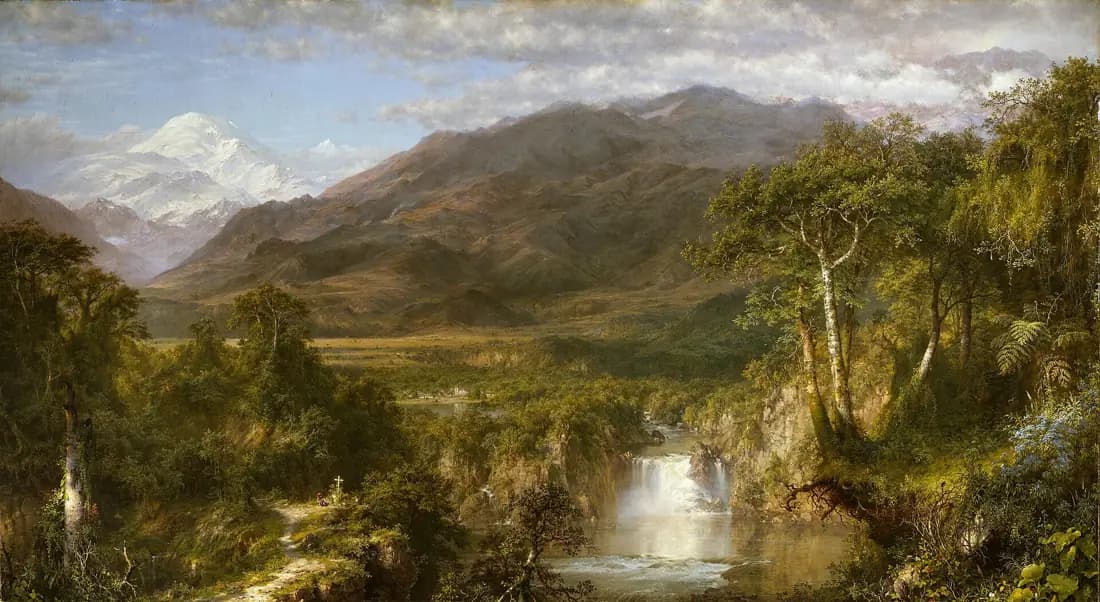
A continent assembled in the studio
Church visited South America in 1853 and 1857, drawing plants, rock formations and mountains in Ecuador and Colombia. The final view is not one place. It combines those observations into a continuous descent from snow and thin air through temperate slopes to dense tropical growth.
Humboldt's nature in paint
The German naturalist Alexander von Humboldt described the Andes as a connected system in which altitude, climate, geology and vegetation could be read together. Church makes that idea visible. A viewer can follow water down the mountain and study changing plants almost as if travelling through an illustrated scientific cross-section.
A painting staged as an expedition
When first exhibited, The Heart of the Andes stood alone in a dark room behind curtains, in a frame resembling a window. Visitors were encouraged to use opera glasses. The theatrical display turned close looking into travel, while the tiny church and cross in the foreground supplied a human scale for a landscape designed to feel inexhaustible.
A landscape designed to be explored
Church filled the foreground with routes for the eye: a stream, a footpath, leaning trees and small figures all lead inward at different speeds. No single element explains the whole terrain. Tropical plants crowd the near bank, cultivated land opens farther back, and the snow peak belongs to another climate altogether. The painting compresses an enormous change in altitude into one continuous journey.
Its original display encouraged that slow exploration. Viewers paid to see the painting in a darkened room, where it was presented in an elaborate frame and examined almost like a destination. The format sits between picture and experience. Today its geographical synthesis should not be mistaken for a neutral survey, but the density still performs its first invitation: move closer, choose a path and keep discovering.
Sources and further reading
- The Metropolitan Museum of ArtTravels, Humboldt, display and object details.
- The Met publication, Church's Great PictureExhibition history and extended scholarship.