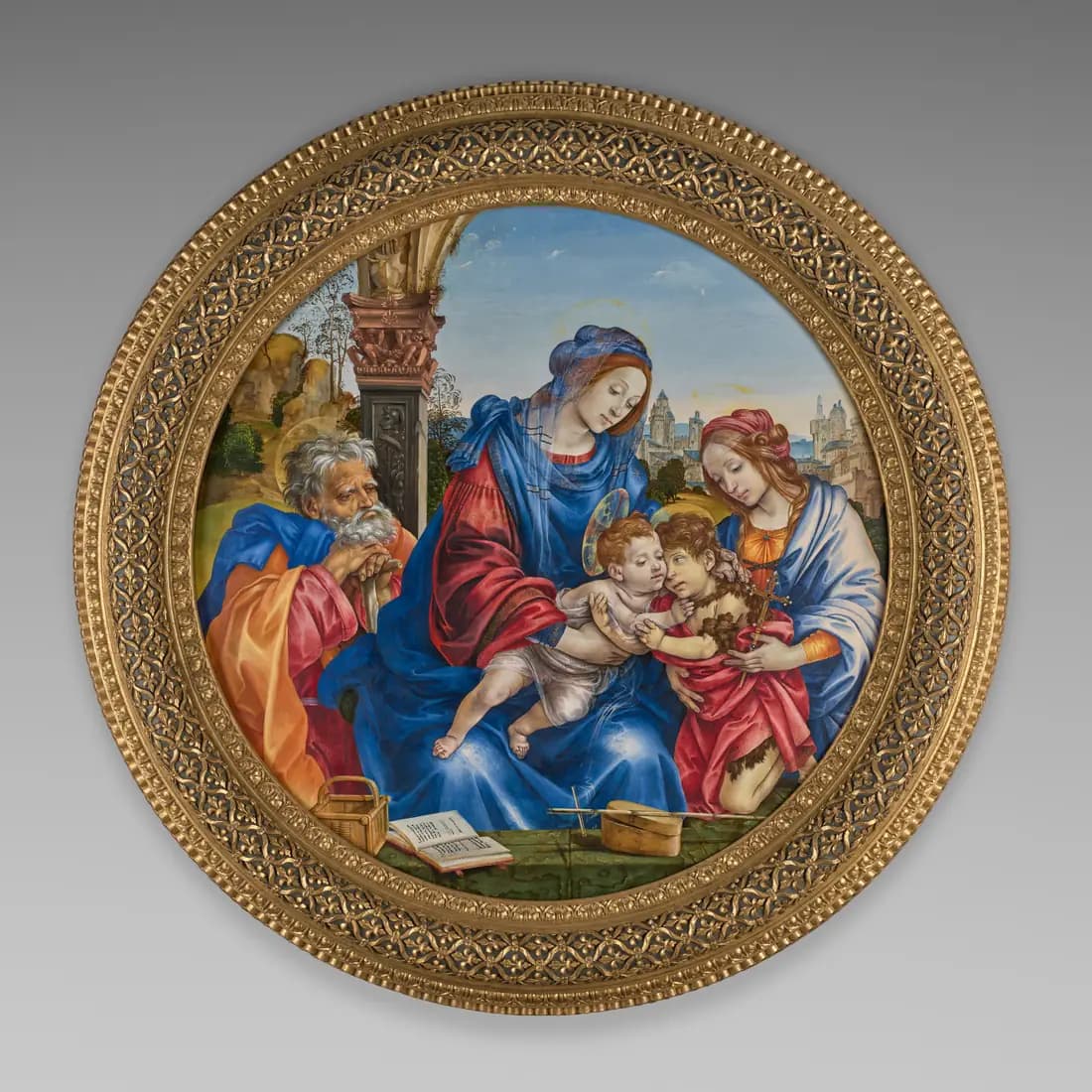
Five figures turn inside a circle
Mary and the infant Jesus occupy the center, but the composition does not settle into a simple pyramid. Joseph leans in from the left, the young Saint John rises below, and Saint Margaret bends from the right. Their bodies overlap so closely that hands, faces, and fabrics seem to turn like linked parts around the round edge.
This circular format, called a tondo, was often made for a domestic setting. Filippino uses its shape actively: no corner offers an escape, so affection and attention remain concentrated within the family group.
Blue carried a material cost
Mary's robe is built from ultramarine, a pigment made from imported lapis lazuli. The Cleveland Museum notes that it could cost more than gold. Its brilliance therefore speaks not only through color but through expenditure, marking the central figure with a material that a patron would recognize as exceptional.
Red, violet, green, and patterned cloth crowd around that blue. Filippino keeps the palette intense while using the figures' glances to prevent it from breaking into unrelated patches.
Antiquity enters the sacred scene
Filippino worked in Rome from about 1489 while completing Cardinal Oliviero Carafa's chapel. The Met describes how he studied ancient remains there and interpreted their forms freely. For Saint Margaret, a surviving preparatory drawing adapts the pose of an antique Venus rather than copying it unchanged.
That borrowing is not a secret conflict within the painting. Renaissance artists treated ancient bodies, drapery, and ornament as a visual language that could be redirected toward Christian subjects.
A commission connects Florence and Rome
The museum links the panel to Cardinal Carafa, whose Roman chapel was Filippino's major project in these same years. Whether viewed as an intimate devotional image or a prestigious commission, the work carries lessons gathered across two cities: Florentine figure painting, Roman antiquity, and a patron's costly materials.
Its achievement is compression without stillness. Each saint is individually readable, yet no one stands apart. The circle turns a collection of holy figures into a close, almost bodily encounter.
Sources and further reading
- Cleveland Museum of Art collection recordExact object, figures, commission, materials, ultramarine, and antique source.
- Metropolitan Museum of Art, Filippino LippiFilippino's Roman years, Carafa Chapel, and study of antiquity.