The poem enters its final movement
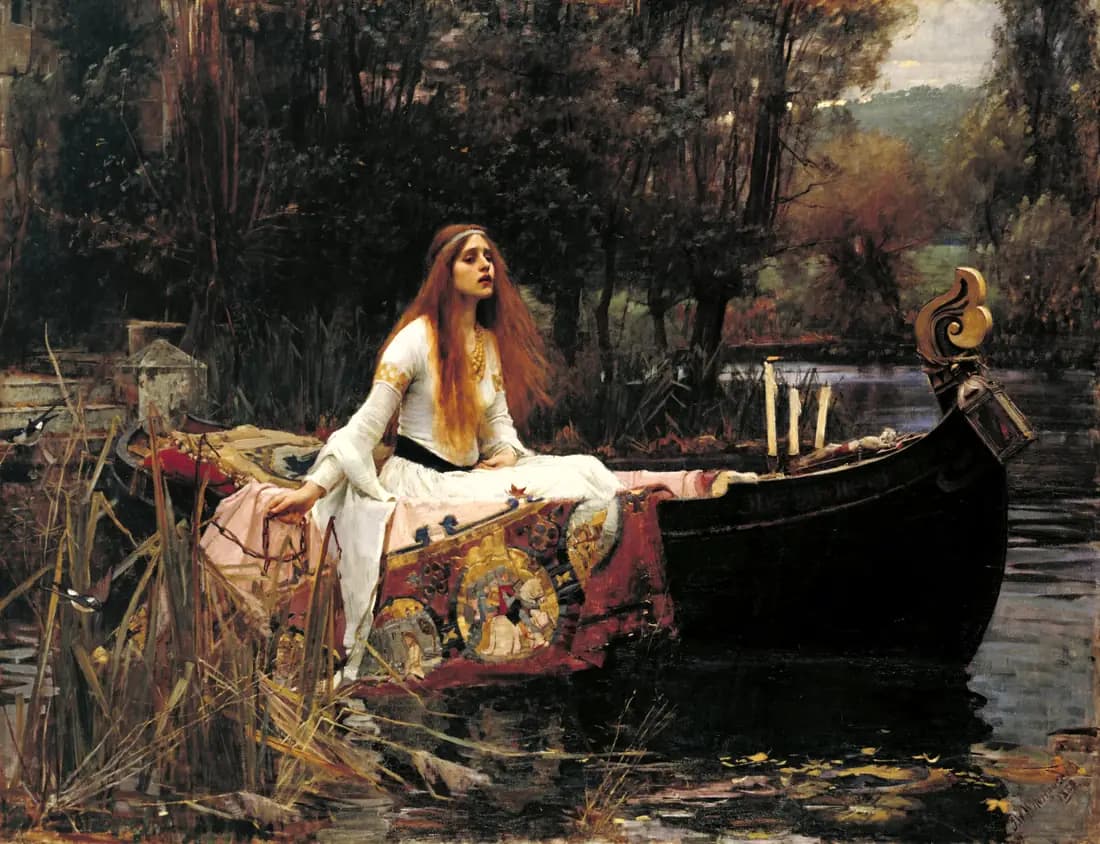
Tennyson's Lady lives under a curse, seeing the world only through a mirror while weaving its reflections. After looking directly at Lancelot, she leaves her tower and writes her name on a boat. Waterhouse chooses departure rather than arrival: the chain is loose, the river open and Camelot still unseen.
Objects count down the scene
The tapestry she wove slides across the boat and into the water. Three candles stand near a crucifix; two are already extinguished in many readings, leaving one flame. Fallen leaves and flattened reeds add seasonal decline. These signs are carefully staged, but the hand on the chain keeps the symbolism tied to one physical action.
A medieval story in an English landscape
Waterhouse painted from a model and close studies, combining Pre-Raphaelite detail with a softer atmospheric surface. The riverbank feels observed rather than fantastical. That familiarity makes the literary event more immediate: doom is not announced by a supernatural spectacle, but by a young woman quietly setting a boat free.
The boat is already a warning
Details tell the ending before the journey begins. One chain remains in the woman’s hand, fallen leaves lie on her lap, two candles have gone out and a tapestry trails toward the water. The prow bears her name, turning the boat into both vehicle and memorial. Waterhouse lets narrative accumulate through objects while her face remains controlled.
Only one candle still burns. It is tempting to translate every object into a fixed symbol, but the scene is stronger when they also retain ordinary functions. The chain moors the boat; the tapestry is the work she abandons; candles can fail in open air. Their practical presence makes the literary fate believable. A richly finished landscape surrounds a moment whose danger arrives quietly.
Sources and further reading
- Tate collection entryPainting, poem, symbolism and exhibition history.
- Tate, Pre-Raphaelite artInstitutional context for the movement that shaped Waterhouse's art.