A frame grown from a tree
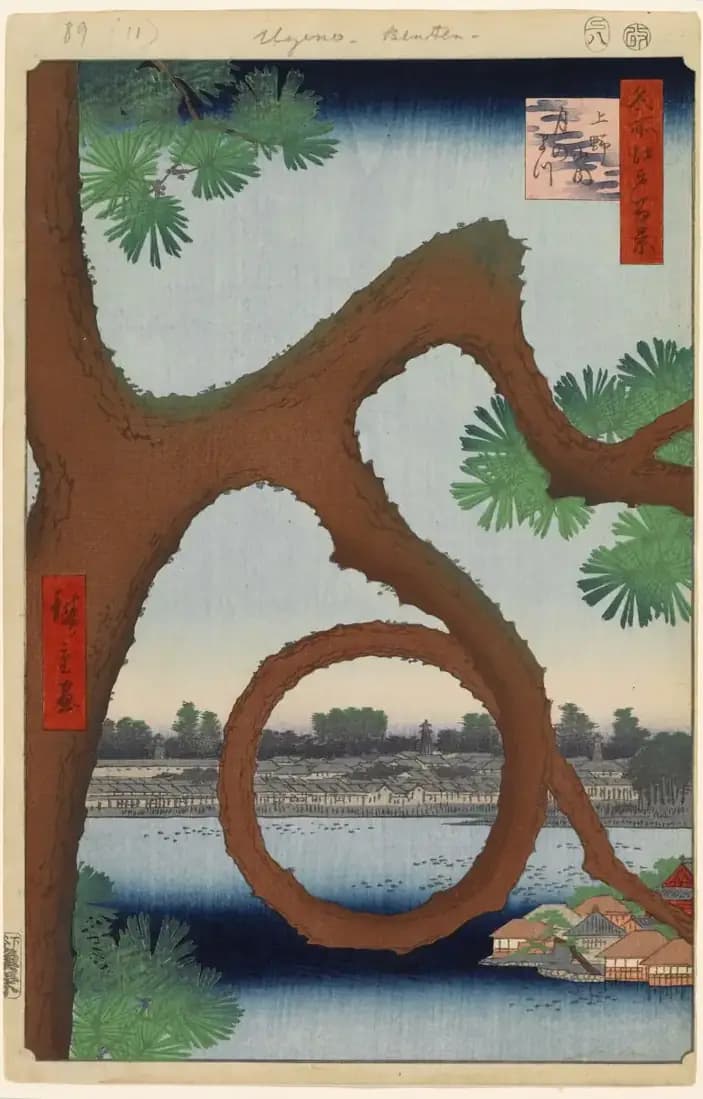
The old pine was celebrated for a branch that curled into a near circle. Hiroshige brings that loop close enough to dominate the sheet. Its rough needles and dark trunk surround a much finer distant scene, turning a piece of living wood into both subject and viewing device.
Near and far occupy one surface
Inside the loop stands a hall of Benten shrine on an island in Shinobazu Pond. The building is tiny, yet its placement makes it impossible to miss. Edo prints often use exaggerated foreground objects to give depth to a vertical format; here the device also recreates the pleasure of finding a view through the tree.
A landmark that did not survive
Visitors came to see the Moon Pine at the Kiyomizu Kannon temple in Ueno. The original tree was lost in the Meiji period, although a successor has since been trained into a loop. Hiroshige's print preserves not simply a botanical curiosity but a particular way Edo residents looked through it at their city.
A circle that never quite closes
The pine’s loop is irregular, open and alive. Needles interrupt its edge, small branches escape outward, and the thick trunk enters from below without becoming a tidy border. Those imperfections keep the device from feeling like a drawn telescope. Hiroshige makes us aware that a real tree has been trained, admired and used to organise a view.
The central temple is not simply enlarged by the frame. The surrounding pond, roofs and distant land remain visible through and around the branch, so the eye alternates between looking at the pine and looking through it. That shift is the print’s quiet game. An object famous enough to be the destination also becomes the means by which another landmark is seen.
Sources and further reading
- Brooklyn Museum collectionObject record and the Moon Pine as an Edo landmark.
- The Metropolitan Museum of Art collection searchRelated impressions and series context.