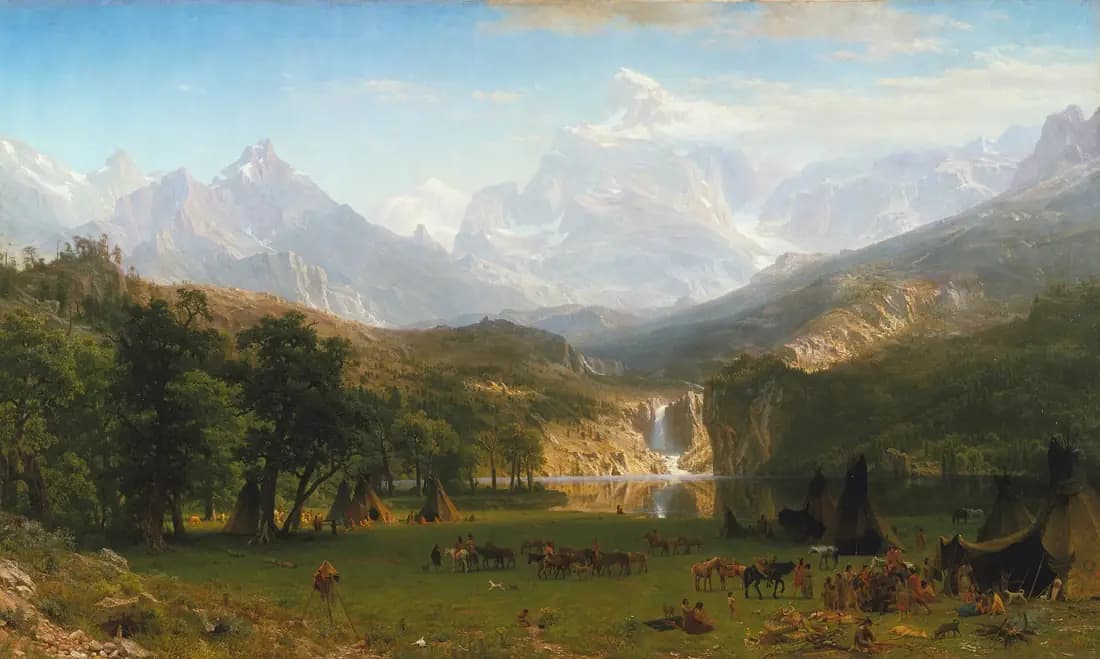
An expedition becomes a panorama
Bierstadt travelled west with Frederick W. Lander's government survey expedition in 1859. In the Wind River Range, in present-day Wyoming, he made drawings and oil studies. The finished painting was composed later in New York. At more than three metres wide, it turns those portable observations into an enveloping spectacle.
A landscape arranged for wonder
Water carries the eye from the foreground lake to a bright waterfall and finally to the central peak. Sunlight selects patches of grass, rock and snow while clouds make other areas recede. The scene feels discovered at one perfect instant, but its clarity comes from selection, enlargement and careful studio construction.
Who is inside the view?
A Shoshone encampment is visible below the mountains. Nineteenth-century viewers often read such paintings through Manifest Destiny, imagining western land as available for settlement. That story had severe consequences for Indigenous peoples whose presence the painting records but whose claims expansion denied. The grandeur is real; so is the political vision built into its presentation.
Scale is the painting’s argument
Bierstadt layers several kinds of distance into one view. Animals and figures establish the foreground, the bright waterfall marks a middle zone, and the peak rises beyond both. Each passage offers enough detail to feel observed, yet the total arrangement is more comprehensive than a single viewpoint could provide. The painting asks the eye to travel before it can grasp the mountain’s scale.
That persuasive grandeur deserves a double reading. It records Bierstadt’s genuine excitement before western geology and light, but it also packages the land for viewers far away. The foreground community proves that the place was inhabited, even as the panoramic format encouraged an idea of untouched wilderness. Looking closely means holding the visual achievement and the historical contradiction in the same frame.
Sources and further reading
- The Metropolitan Museum of ArtObject record, expedition history and Native perspective.
- The Met, Fort Laramie studiesField studies and their relationship to figures in the painting.