Pleasure turns into punishment
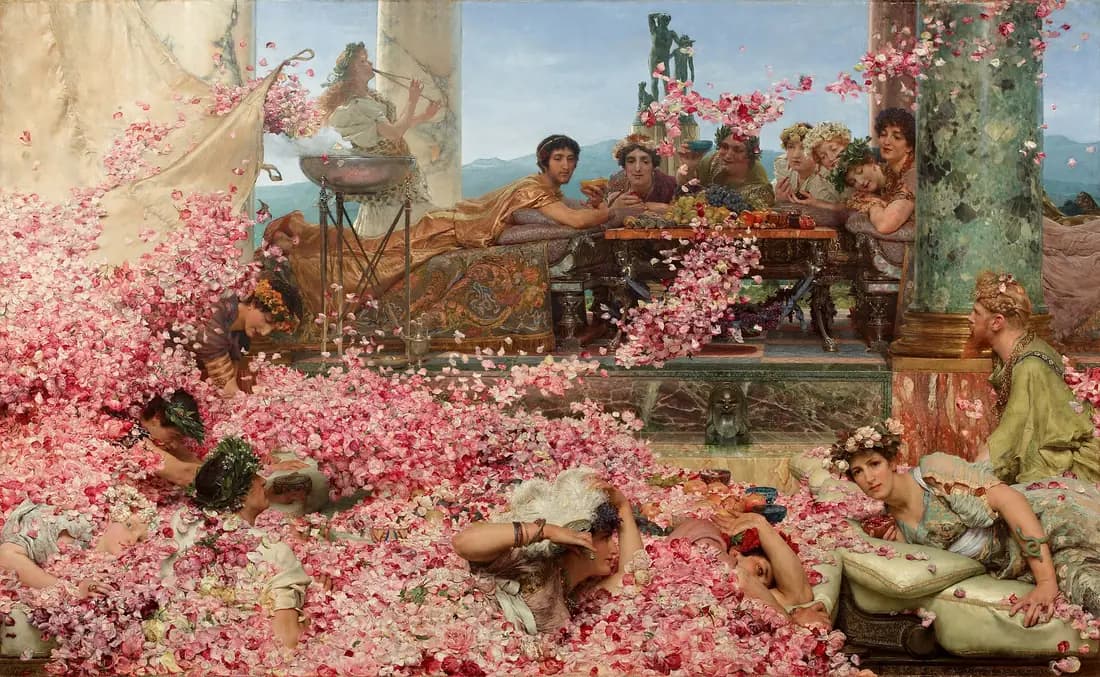
At the upper level, the young emperor reclines beneath a bronze statue of Dionysus. Below, guests struggle or disappear under petals released from a false ceiling. Alma-Tadema delays the violence. Marble, silver, fabric and flowers first offer the polished luxury expected of his imagined ancient Rome.
An ancient story with weak foundations
The episode derives from the Historia Augusta, a collection of imperial biographies written long after the events and notorious for inventions. The text says victims were smothered with violets and other flowers. Alma-Tadema chose roses, intensifying colour, abundance and the contrast between beauty and cruelty.
Archaeology serving theatre
Alma-Tadema studied ancient objects and architecture closely, yet combined them freely to create persuasive scenes. The painted rose varieties are said to have been supplied during a winter sitting so that he could observe fresh petals. Exact detail makes the impossible shower feel tangible, while the composition leaves us to notice its horror gradually.
Beauty becomes the instrument of danger
The rose petals first appear impossibly luxurious. Their pale pink mass fills the foreground, catches the light and echoes the marble architecture. Only gradually do faces, hands and overturned bodies reveal what is happening beneath them. Alma-Tadema makes recognition arrive late, so the attraction of the painted surface becomes part of the cruelty.
The story comes from an ancient account whose reliability is doubtful, and the emperor’s reputation was shaped by hostile later writers. The painting is therefore not a documentary view of Rome. It is a nineteenth-century spectacle built from archaeological research, theatrical imagination and a sensational text. Looking at it critically does not cancel its craft. It explains why polished historical detail can make an invented event feel authoritative.
Sources and further reading
- Leighton House, past exhibitionsThe painting and its display in A Victorian Obsession.
- Royal Academy, Alma-TademaInstitutional artist record and classical painting context.