Ice as architecture
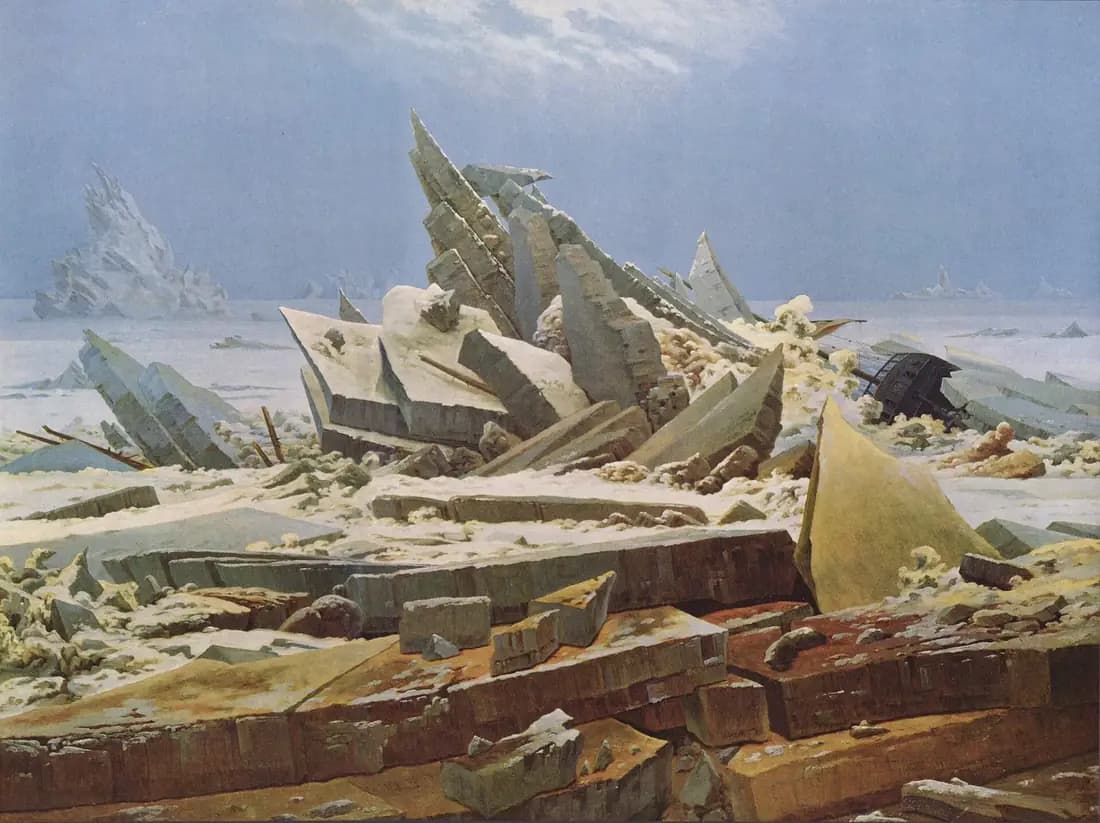
Broken sheets thrust diagonally toward a central peak, repeating like collapsing roofs or tombstones. Brown, green and blue layers make the ice heavy rather than decorative. There is no safe foreground and no figure through whom to enter the scene.
The wreck at the edge
The painting was associated with the failed Arctic expedition of William Edward Parry, although Friedrich did not provide a simple documentary account. A ship's stern lies crushed at the right. Its scale turns exploration from heroic narrative into a small episode inside indifferent natural force.
An Arctic made without travel
Friedrich observed ice floes on the Elbe near Dresden during a severe winter and made studies of their fractured forms. Published polar accounts supplied further imagination. The finished scene is therefore invented but not arbitrary: close local observation becomes the material for a place he had never seen.
The wreck is not the largest ruin
A ship’s stern can be found at the right, crushed and nearly absorbed by broken ice. Friedrich does not centre it. The main monument is the jagged mass rising in the middle, where slabs have been pushed into a structure more severe than any human architecture. Discovery begins with landscape, and only afterward becomes a story of failed passage.
The older title The Wreck of Hope encouraged an allegorical reading, although it was not Friedrich’s own title for the work. The painting needs no invented subtitle to communicate catastrophe. Repeated diagonals prevent the eye from finding a safe route, and cold colour removes any comforting distance. Unlike a storm scene, this disaster feels arrested. The ice has already moved, broken the vessel and become still again.
Sources and further reading
- Hamburger Kunsthalle online collectionObject record, title, dating and interpretation.
- Staatliche Museen zu Berlin, Friedrich exhibition textsFriedrich's studies, construction and landscape practice.