Architecture becomes a sequence
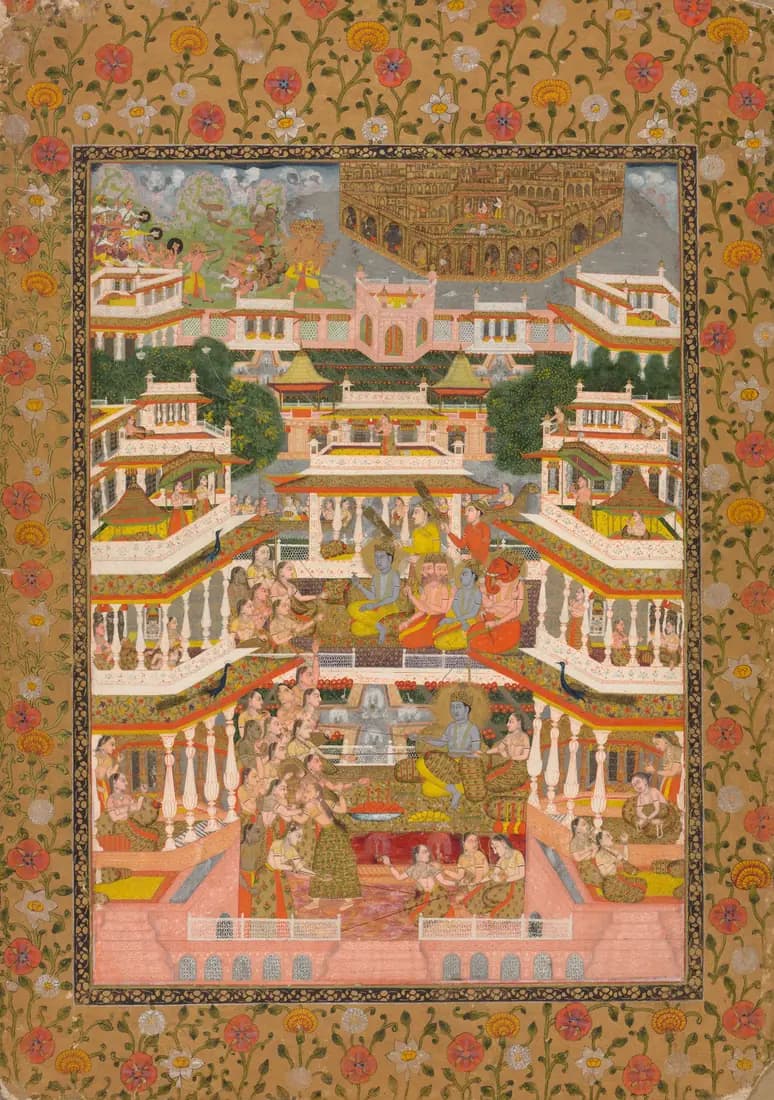
The eye enters through a floral border, then meets a building that behaves like a vertical stage. Balconies, stairs, garden walls, and pavilions divide the page into registers. Each level contains a different scale of action, yet repeated white railings and red accents keep the whole structure connected.
This is not one palace observed from a possible viewpoint. Chitarman II uses architectural clarity to make simultaneous stories readable. Looking upward becomes a form of narration.
The top contains an epic
At the top, Rama slays the demon of Lanka's golden city. The Cleveland Museum identifies the scene as an episode from the Hindu epic Ramayana. A sea monster below the island lifts its head, a fantastic detail tucked beneath the battle's more formal symmetry.
The upper scene does not turn the rest of the page into an illustration of the same event. Other Hindu deities occupy the middle terraces, enjoying music, flying kites, and boating. Sacred narrative and leisure coexist without sharing one time.
Holi anchors the lower register
At the bottom, Krishna, Radha, and palace women celebrate Holi by spraying red-colored water with plunger guns. Their compact gestures and crossing streams introduce playful disorder beneath the measured levels above.
The museum connects the painting to Emperor Muhammad Shah's renewed court interest in Hinduism. That context helps explain the range of subjects, but it does not make the page a neutral survey of belief. It was an imperial commission shaped for a particular patron and court.
A court painter changes Mughal space
The Metropolitan Museum identifies Chitarman II as a leading painter under Muhammad Shah. It describes his later style as flatter and more geometric than the naturalistic perspective associated with earlier Mughal painting, with figures and architecture arranged almost like a grid.
Those qualities are productive here. Bold color and stacked geometry let an unusually dense program remain legible. The page's wonder lies less in illusionistic depth than in coordination: epic, devotion, season, and pleasure keep their differences while belonging to one carefully ordered surface.
Sources and further reading
- Cleveland Museum of Art collection recordExact work, commission, stacked subjects, Rama, Hindu deities, Holi, medium, and dimensions.
- Metropolitan Museum of Art, Wonder of the AgeChitarman II's career under Muhammad Shah and the geometry, color, and figure painting of his mature style.