The sky occupies the argument
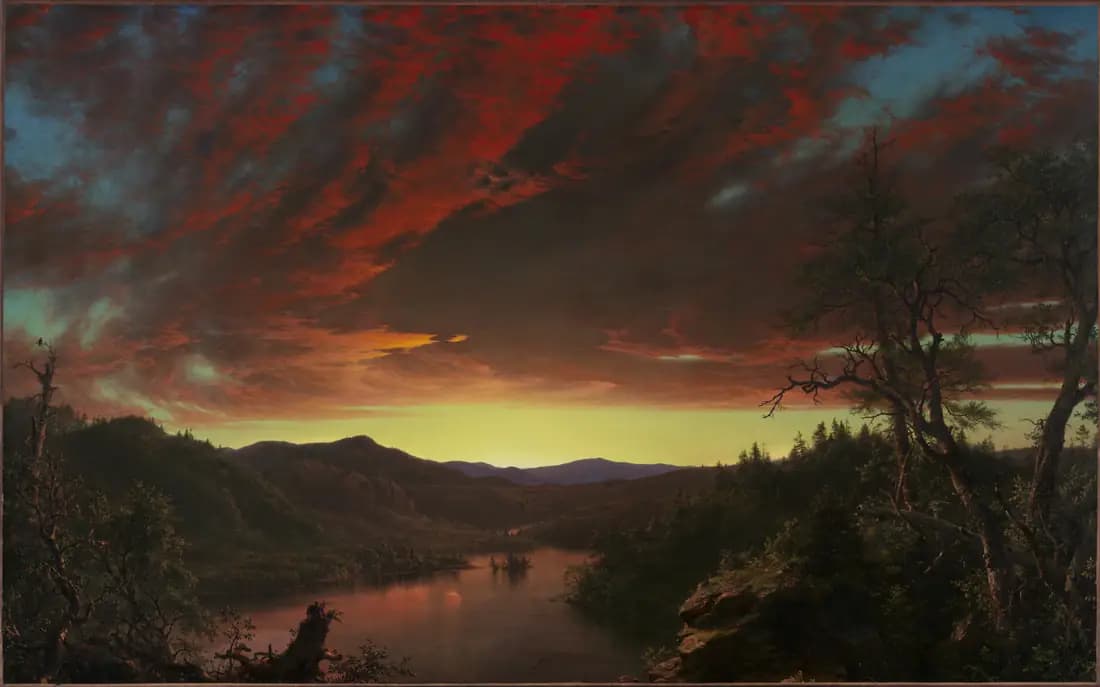
Bands of crimson, orange, violet, and blue spread across most of the canvas. The land below is comparatively dark: water, rocks, and autumn trees form a low stage from which the eye rises. Tiny pale marks in the sky are birds, giving scale to a sunset that otherwise feels almost immeasurable.
Church balances spectacle with precision. Cloud edges catch different kinds of light, while the reflection in the lake is broken by its own surface rather than copied like a mirror.
Wilderness was assembled from studies
The setting draws on Mount Katahdin in Maine, where Church made sketches in 1858. He completed the painting in his New York studio in 1860. That gap makes the scene neither a photograph nor a fantasy. It is a deliberate construction made from remembered weather, field observation, and decisions about scale.
No roads, houses, or people appear. The apparent absence of human intervention was itself designed by an artist working in a large city for an urban audience.
One painting became an exhibition
Church was famous for presenting major landscapes individually, supported by publicity and admission. Cleveland records that this painting drew hundreds of visitors during a seven-week New York display. The format asked viewers to approach one canvas as they might approach a destination.
The National Gallery's survey of Church places such large works among the defining paintings of his mature career. Their public success joined careful landscape painting to the machinery of modern entertainment.
A sunset near a national rupture
The work appeared in the year before the American Civil War began. Some viewers and scholars have read its blood-red sky and solitary eagle as signs of the country's approaching crisis. The Cleveland Museum presents that political meaning as a possibility, not a proven code supplied by Church.
The distinction preserves what makes the painting powerful. We can see impending violence in the color without pretending every cloud has one fixed translation. Twilight is a transition: daylight ends brilliantly, while what follows remains beyond the canvas.
Sources and further reading
- Cleveland Museum of Art collection recordExact object, Maine studies, studio execution, solo exhibition, and Civil War interpretation.
- National Gallery of Art, Frederic Edwin ChurchInstitutional overview of Church's career and large-scale paintings of the late 1850s and 1860s.