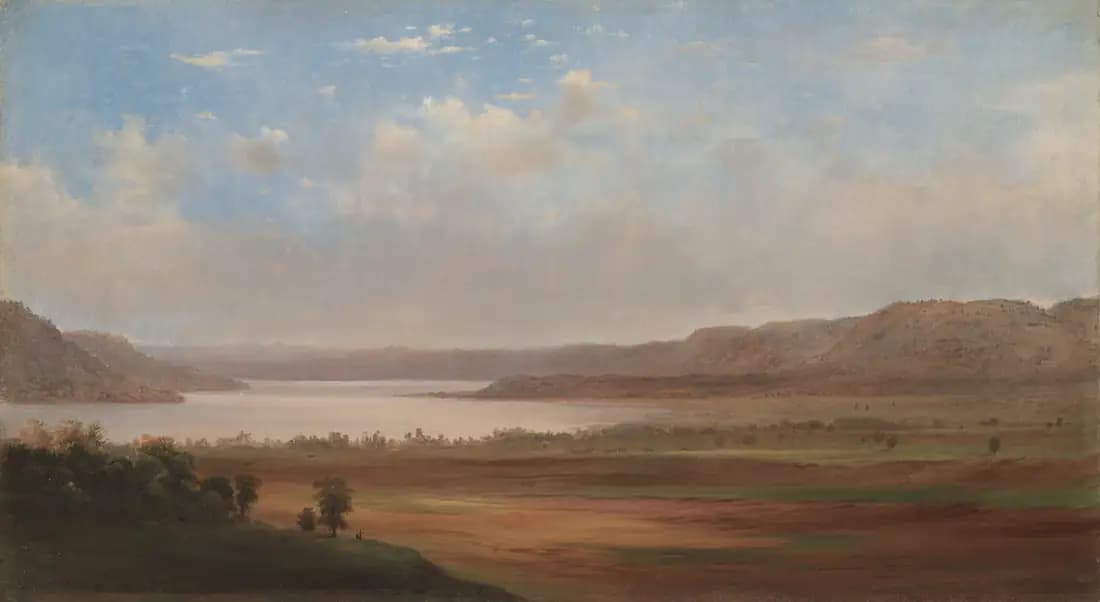
Distance begins in the foreground
Dark trees and small figures hold the lower edge of the canvas. Beyond them, cultivated fields descend toward Lake Pepin along the Mississippi River. The opposite bluffs are softened by distance, and the sky occupies almost half the picture. Duncanson builds great scale from an unusually low, quiet scene rather than from a spectacular peak or waterfall.
That spacious design asks the eye to travel slowly. Repeated horizontal bands of shore, water, hills, and cloud carry attention into depth, while patches of warm ground keep the foreground connected to human use.
Observation becomes an ideal landscape
The title names a real place, but the painting is more than a topographical record. Duncanson arranges light, weather, and land into a harmonious whole. The Smithsonian describes this ideal of rural America as Arcadian in his work: nature appears fertile and inhabitable, with human life held inside a much larger order.
The small scale of the people matters. They establish the breadth of the scene without becoming its story. Lake, air, and cultivated earth remain equal participants in the view.
A journey north in 1862
Duncanson painted Lake Pepin while traveling from the Mississippi Valley toward Canada. The Cleveland Museum connects that movement with the upheaval of the Civil War. He worked for a time in Montreal and London, extending a career that had already made him the best-known African American painter of his era.
His international success was exceptional in a country where slavery still existed. The calm surface of this painting should not erase that history. Instead, the contrast makes the work more resonant: serenity was produced during movement through a divided nation.
Light offers no simple escape
The brightest area lies far away, where pale water meets the distant shore. No road leads cleanly toward it, and the figures remain near the darker foreground. Duncanson gives the viewer openness without turning the scene into a promised destination.
What lasts is the balance between place and passage. Lake Pepin is specific, yet the measured recession lets it become a meditation on how distance can hold both possibility and separation.
Sources and further reading
- Cleveland Museum of Art collection recordExact work, 1862 journey, Civil War context, Montreal, London, and Duncanson's recognition.
- Smithsonian American Art Museum, Landscape with RainbowDuncanson's career, abolitionist patrons, European study, and Arcadian approach to landscape.