Tenderness is built through contact
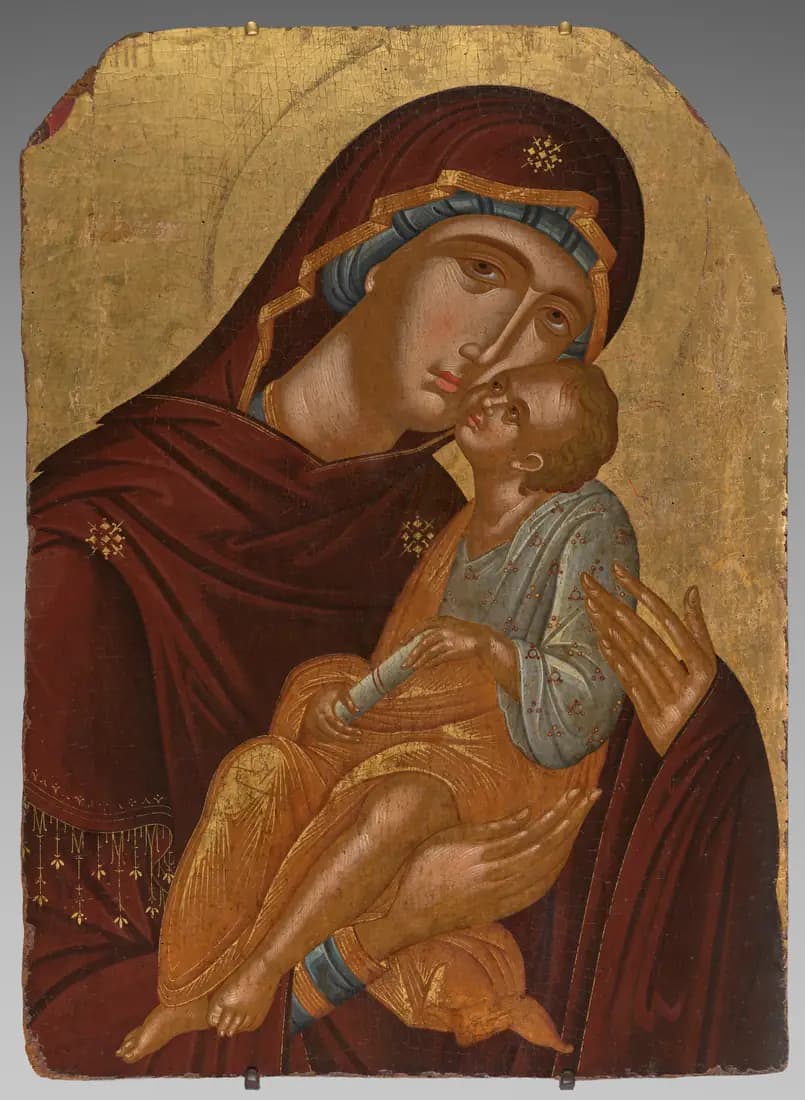
Mary supports Christ with both hands as he leans across her chest. Their cheeks meet beneath the curved edge of her dark red mantle. His small hand reaches upward, and their interlocking arms concentrate attention on physical contact.
The title Eleousa identifies a Virgin of Tenderness. Affection does not become a private snapshot: gold removes ordinary setting, and the figures retain the frontal clarity of a sacred image. Human touch and spiritual authority occupy the same surface.
An icon lived through response
At 96 centimeters high, the panel likely belonged to an iconostasis, the screen separating an Orthodox church's sanctuary from the congregation. It would have been encountered upright within worship, alongside other images and liturgical movement.
Cleveland's study explains that icons were bowed to, crossed before, kissed, touched, illuminated by candles, and sometimes carried in procession. Such use matters to how the object is understood. The painting offered a stable image, but devotion completed its social life through repeated action.
The attribution remains careful
The museum attributes the icon to Angelos Akotantos, a leading painter in fifteenth-century Crete, rather than presenting a signature on this panel as proof. Its technical study compared the faces, drapery, materials, and method with signed icons examined by the Benaki Museum.
Cleveland dates it to about 1425-50, during Angelos's most active period. The collection record also keeps the place of production open between Candia in Venetian Crete and Constantinople. Quality and comparison make the attribution strong, but uncertainty belongs in the name.
Cretan icons traveled
Angelos likely ran a large workshop in Candia and supplied Orthodox churches and monasteries beyond Crete. His surviving subjects and locations reveal an art made within networks of worship, trade, and artistic exchange rather than an isolated island style.
The museum also traces demand for Cretan Marian icons in Ethiopia, where Emperor Lebna Dengel sent monks to acquire them in the early 1500s. That later history is broader than this panel's documented journey. It shows how a recognizable sacred format could cross languages, jurisdictions, and theological differences.
Sources and further reading
- Cleveland Museum of Art collection recordExact icon, attribution, date, medium, dimensions, likely setting, and Cretan and Ethiopian context.
- Cleveland Museum of Art, The Virgin EleousaTechnical attribution, Cretan workshop context, icon veneration, conservation, and comparison with signed works.