Looking at somebody looking
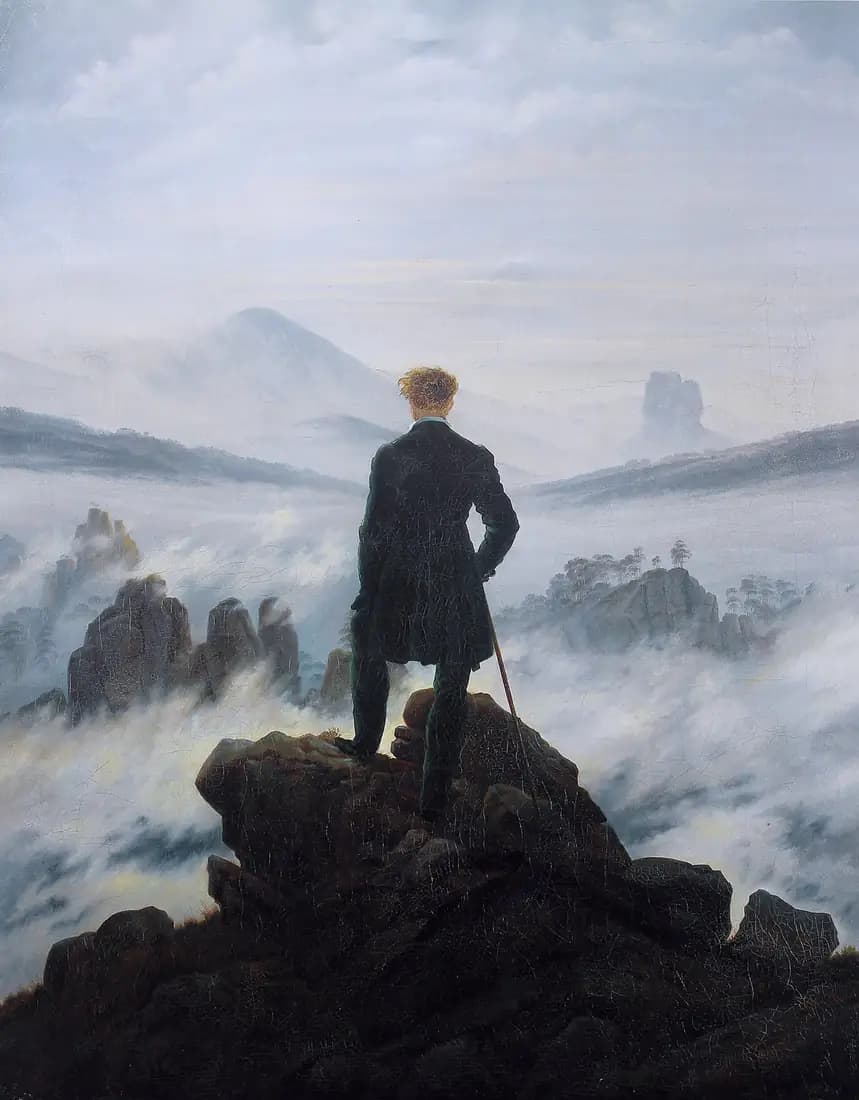
A man has climbed above the fog, but Friedrich does not let us share his view cleanly. The dark coat and walking stick occupy the centre of the painting. The figure draws us forward and stops us at the same time: his rocky perch is not obviously reachable, and his body hides the landscape directly ahead.
Friedrich often used a figure seen from behind, known in German as a Rückenfigur. Here that device is unusually forceful. The painting is one of his relatively few portrait-format landscapes, and he rarely made a single person so large and unavoidable.
Rock, mist and the sublime
Jagged peaks rise from the fog like islands. Nearby rock is solid and sharply described; distance dissolves into blue-grey layers. The contrast joins two kinds of time: stone that appears ancient and weather that may vanish within minutes.
For Romantic artists, mountains could inspire the sublime, a feeling in which beauty, danger, awe and human smallness meet. The wanderer may look triumphant, uncertain or simply absorbed. Friedrich withholds his face, so no single emotion settles the scene for us.
An icon with no fixed identity
The man has often been treated as a stand-in for the viewer, and sometimes identified as a particular historical person. The Hamburger Kunsthalle is more cautious: what matters is not a solved identity but the act of seeing. We do not look through the wanderer. We look at him looking.
That open structure helps explain the painting’s extraordinary afterlife. It has been quoted, parodied and recreated far beyond art history. Yet its most familiar promise, that we can place ourselves in the wanderer’s position, is exactly what the composition refuses to grant completely.
Sources and further reading
- Hamburger Kunsthalle online collectionDating, dimensions, unusual format and the painting’s meditation on seeing.
- The Metropolitan Museum of Art, The Soul of NatureMountains, mist, geology and the Romantic sublime.
- National Museum in Szczecin, Friedrich’s WeekBirth date and Greifswald context.