Guide
Multiplayer Mahjong Solitaire: Not-So-Solitaire with Friends
Mahjong Solitaire is usually a quiet conversation between you and a pile of tiles. You spot a pair, uncover a new possibility, and find your rhythm as the board opens up.
Now you can share that conversation. In Mahjong Tide, two to eight players can meet at a private table and choose between two ways to play: Race, where everyone clears their own board, and Together, where you take turns clearing one board as a team.
There is no account required to join or create a table. Share an invitation, choose your portraits, and decide whether this evening calls for friendly competition or a little cooperation.
The same matching game, with company
This is multiplayer Mahjong Solitaire, not the traditional multiplayer game of Mahjong. There are no hands to build, no drawing and discarding tiles, and no Mahjong scoring combinations to learn.
The familiar Solitaire rules still apply. Remove matching pairs of free tiles: a tile must have nothing covering it and at least one open side, left or right. Removing one pair changes what you can reach next. Looking beyond the most obvious match is still the heart of the game.
What changes is who shares the experience. In Race, the puzzle becomes a shared starting point. In Together, every choice becomes part of a shared solution.
Create a private table
Open Multiplayer, set up your player with a name, color, and portrait, then choose Create private table. Your portrait helps friends recognize you during play, especially on a small screen where space is limited.
The person who creates the table chooses the mode, the goal, and the boards. Invite friends using the table link, the share option, or a QR code they can scan with their phone camera. Each friend opens the invitation, sets up their player, and chooses Ready to join the table ready to play. Once everyone is ready, the organizer starts.
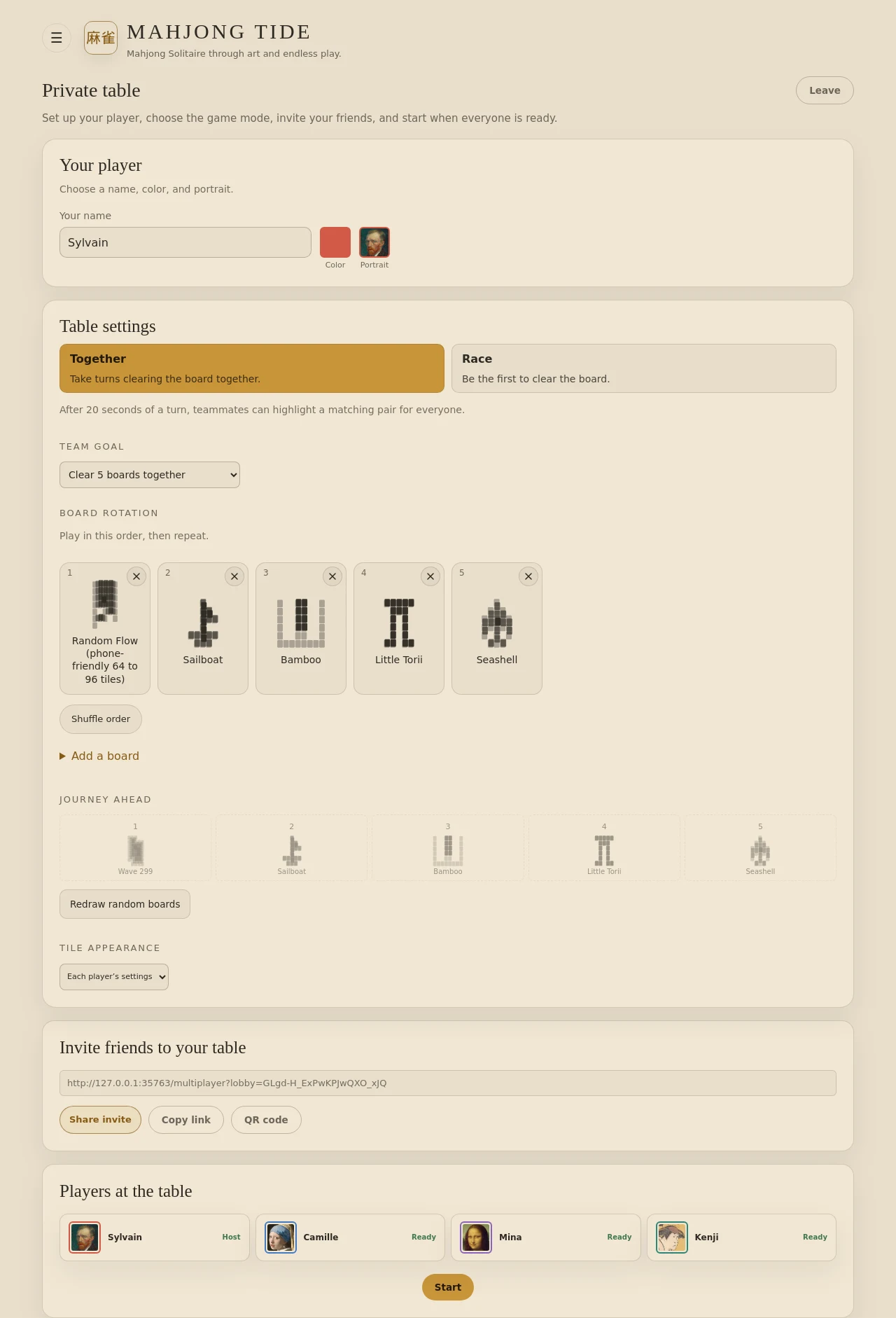
You do not need to sit in the same room or use the same Wi-Fi. Each player needs a browser and an internet connection. You can also play side by side, with one person on a computer and another on a phone.
The table stays together between rounds. You do not have to create another invitation every time you clear a board.
Together: one board, one team
In Together, everyone sees the same board, but only one player removes a pair at a time. After that move, the turn passes along the team.
This gives you room to look without racing a friend to the same pair. While someone else plays, you can think about what their choice might uncover, watch a promising opening develop, or simply enjoy seeing the board take shape.
If a turn lasts 20 seconds, teammates can suggest a pair. Choose two matching, playable tiles and they are highlighted for everyone in your color. A suggestion does not remove the pair: the player whose turn it is still makes the decision.
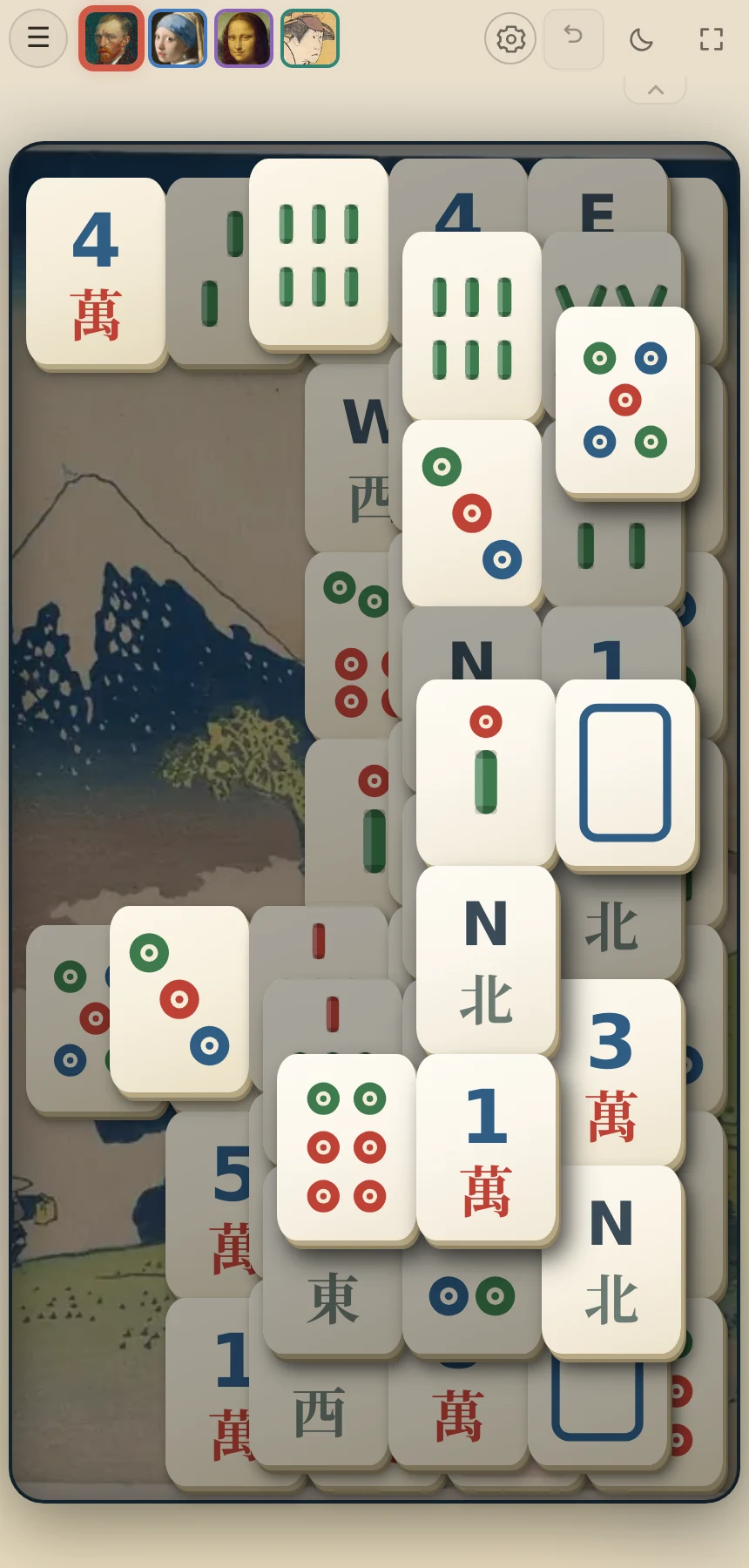
Quick successive moves can also keep a team chain going across turns. That gives the group a small shared challenge without making speed the only point of the game. Sometimes the satisfying move is a quick match; sometimes it is taking a moment to avoid a trap.
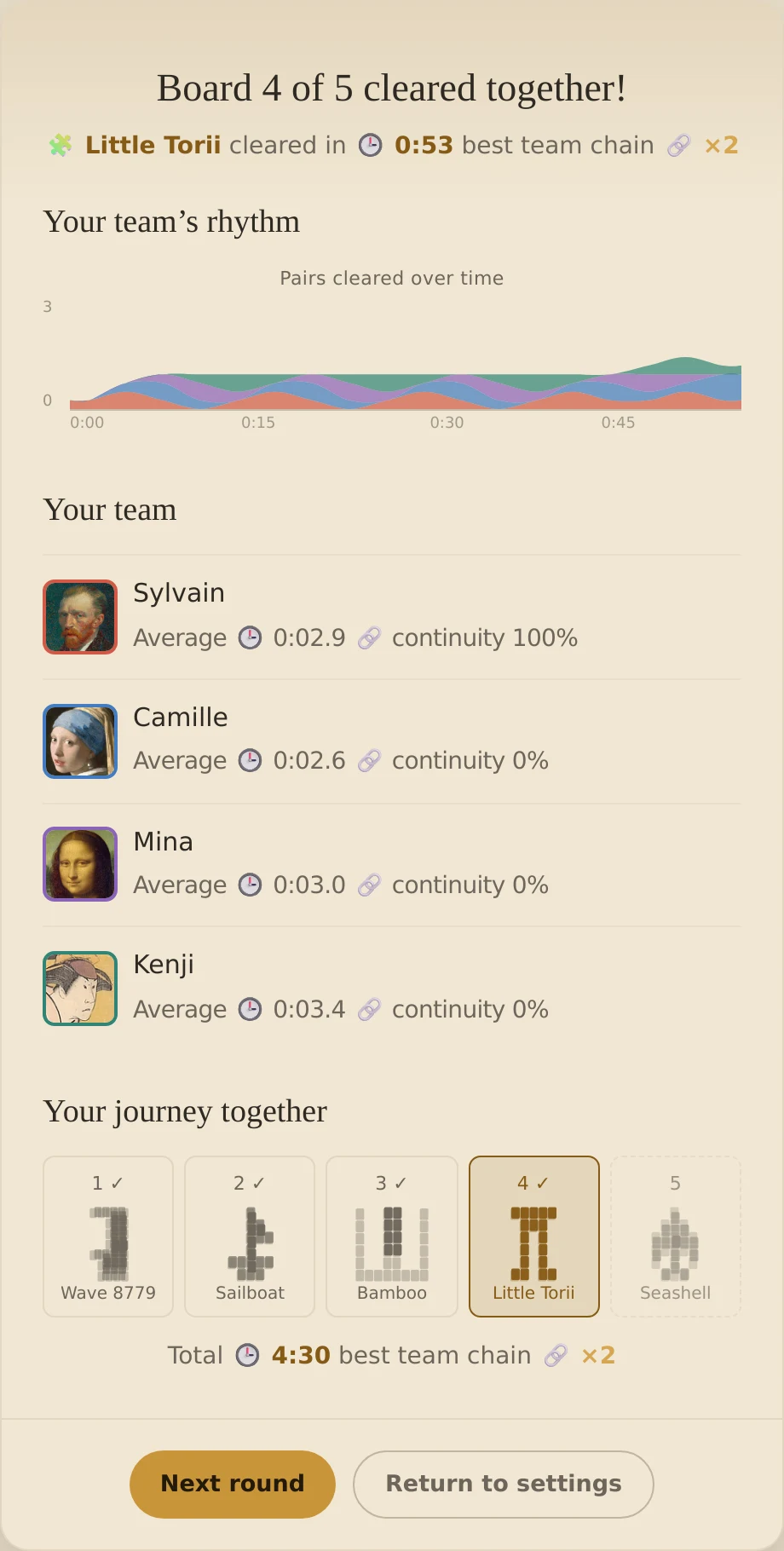
The organizer chooses a goal of one to ten boards. At the end of each board, the results show the team's progress, rhythm, and best chain. The journey strip records the boards you have cleared together and the ones still ahead.
Race: the same start, different decisions
In Race, everyone begins with the same layout and the same tile distribution. You play independently, so removing a pair changes your board, not anyone else's.
The competition comes from reading the board, choosing useful pairs, and finding your own rhythm.
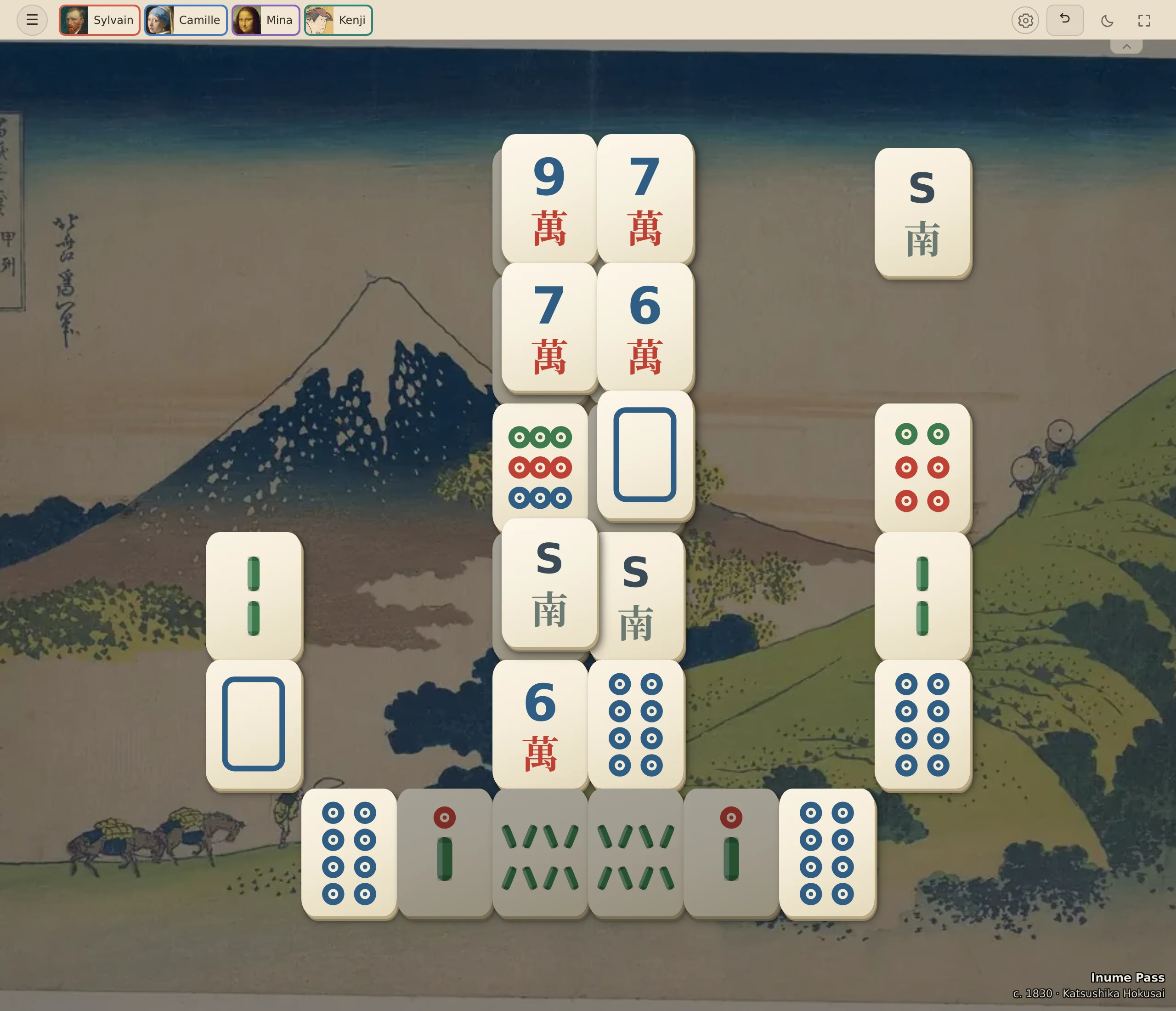
The first player to clear their board wins the round. With more than two players, the others can continue: the round ends when all but one player has finished. The results rank the players who cleared their boards and show how many tiles the remaining player had left.
For a longer contest, choose a target of up to ten round wins. The match ends as soon as someone reaches that target. A single round is an easy way to try the mode; a first-to-three match leaves room for a comeback.
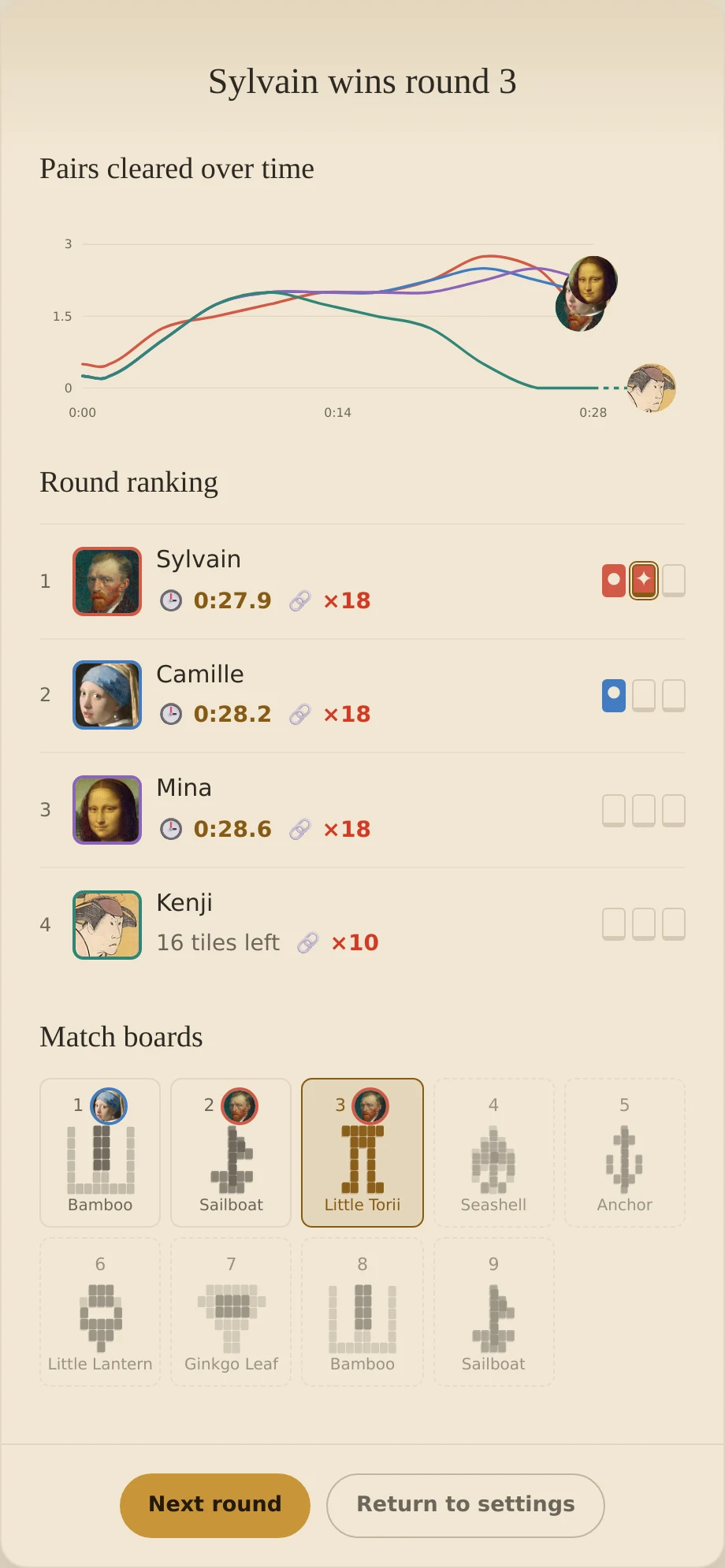
Choose the boards you want to share
A layout is the shape of the tiles. A board is that layout with a particular tile distribution. Multiplayer lets the organizer choose specific layouts or random selections by size, then arrange them in a rotation.
You might alternate a random Mini board with Turtle, or build a sequence of favorite layouts. The rotation repeats if the session needs more boards. The preview shows the planned boards, and Redraw random boards offers another selection without changing the specific layouts you picked.
For phone play, Random Flow draws from compact layouts with 64 to 96 tiles. Mini, Small, Medium, and Full choices are available too. A larger board gives everyone more to explore, but a compact one can make a good first session.
Tile appearance can remain personal, with each player using their own settings, or the organizer can choose the tile sets and backs for the table.
A little help when you need it
Undo remains available in multiplayer. In Race, you can revisit your own decisions. In Together, undo concerns the latest shared move: only the player who removed that pair can undo it.
If the shared board is found to be stranded, the team needs to recover a winnable position before passing the turn. The goal is to solve the board together, not leave the next player with an impossible puzzle.
Keep the game open while playing. It can try to reconnect after an interruption, but a long absence can end your session. If that happens, create a new table and share a fresh invitation.
Start with one compact board and a friend. Try Together if you want to talk through the puzzle, or Race if you both enjoy the moment when the last pair disappears. The quiet pleasure of playing solo is still there. Now there is a way to share it, too.