Guide
Are Mahjong Solitaire Boards Always Solvable?
A Mahjong Solitaire board can have a solution at the start and lose it after one perfectly legal match. In Mahjong Tide, every new deal starts with a solution. Keeping that solution available is the puzzle.
Two different questions
“Is this board solvable?” actually hides two questions:
- Does a winning sequence exist at all? Some games deal tiles at random, and a random deal can be impossible from the very start.
- Have my own moves made it unwinnable? Even on a perfectly solvable board, the order you remove tiles matters. Take the wrong pair and you can strand the tiles you needed - a dead end you created.
A legal match is not proof of a solution
A legal match only checks the two tiles you are selecting: do they match, and are they both free? A solution is a sequence of matches that removes every tile. One can exist without the other.
For example, suppose four copies of a tile remain. Two are outside the stack, and the other two sit directly on top of one another. Matching the outside copies leaves an impossible pair: the lower tile cannot be selected until the upper tile is removed, but the upper tile needs that lower tile as its partner.
This happens on a real Bamboo deal. See the annotated board and play both choices yourself. Other matches remain after the wrong choice, which is why “I can still make a move” and “I can still win” are different claims.
How Mahjong Tide builds a solvable deal
The dealer starts with a layout and finds an order in which pairs of free positions can be removed until it is empty. It assigns matching tile faces to those pairs. That construction supplies a complete clearing sequence for the finished deal; it is not just a random scattering of faces that happens to offer some opening matches.
The sequence proves that at least one solution exists. It need not be the only solution, and you do not have to follow it. The tiles stay where they were dealt until you remove them or undo a move; the game does not rearrange the remaining faces to rescue a position.
What the Winnable indicator tells you
Mahjong Tide checks the remaining position after your moves. If the board becomes impossible to clear, a large red STRANDED message appears across it. The Winnable indicator also turns red and remains there after the message fades, even if some pairs are still playable.
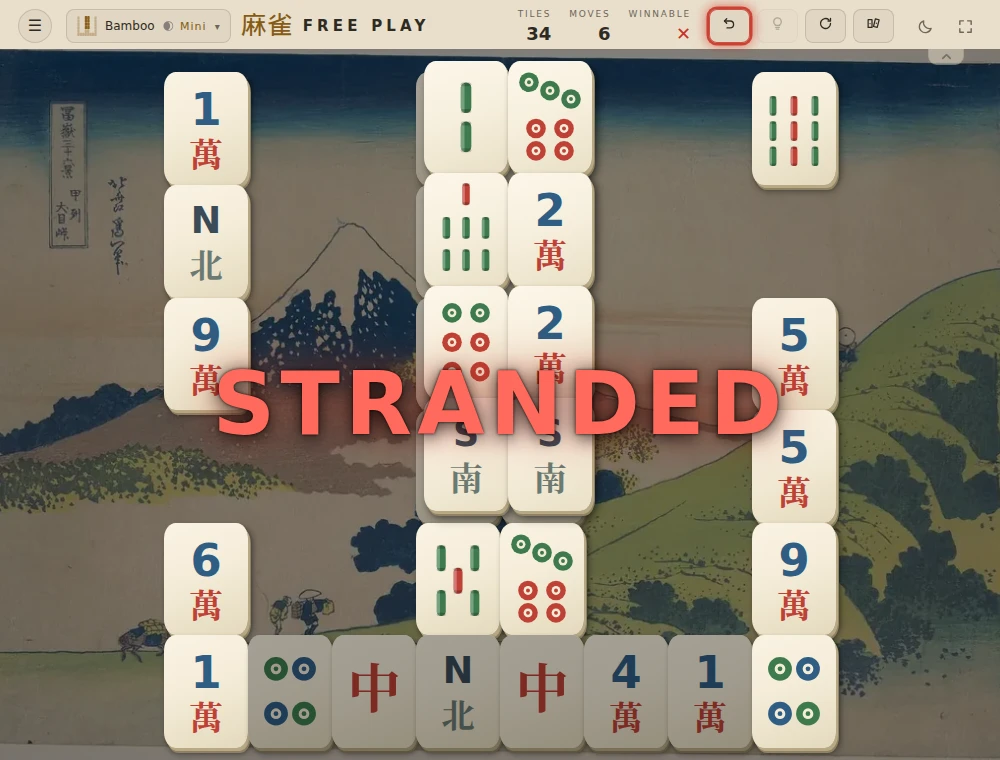
A green check means the game has a clearing sequence. While a check is running, or if it has not reached a conclusion, that is not proof of a dead end.
The warning comes after a move changes the position. It does not prevent you from choosing a legal pair. If you become stranded, Undo offers a return to the last position known to have a solution and shows how many moves it will rewind.
Recovering without changing the puzzle
Undo restores tiles to their earlier positions, so you can try a different pairing with the same information plus whatever the failed branch revealed. Restarting lets you try the original deal again. A new deal changes the puzzle instead.
A solvable start does not guarantee that every decision can be made from visible faces alone. Covered tiles can hide the information you need, so even a promising move can depend on luck. The two strategy examples distinguish a useful opening move from a trap you can predict using visible tiles.