Guide
How to Play Mahjong Solitaire
Mahjong Solitaire is a tile-matching game. The goal is to clear the board by removing matching pairs of free tiles. A full board is 144 tiles; Mahjong Tide also deals 36-, 72- and 108-tile boards for a shorter sitting.
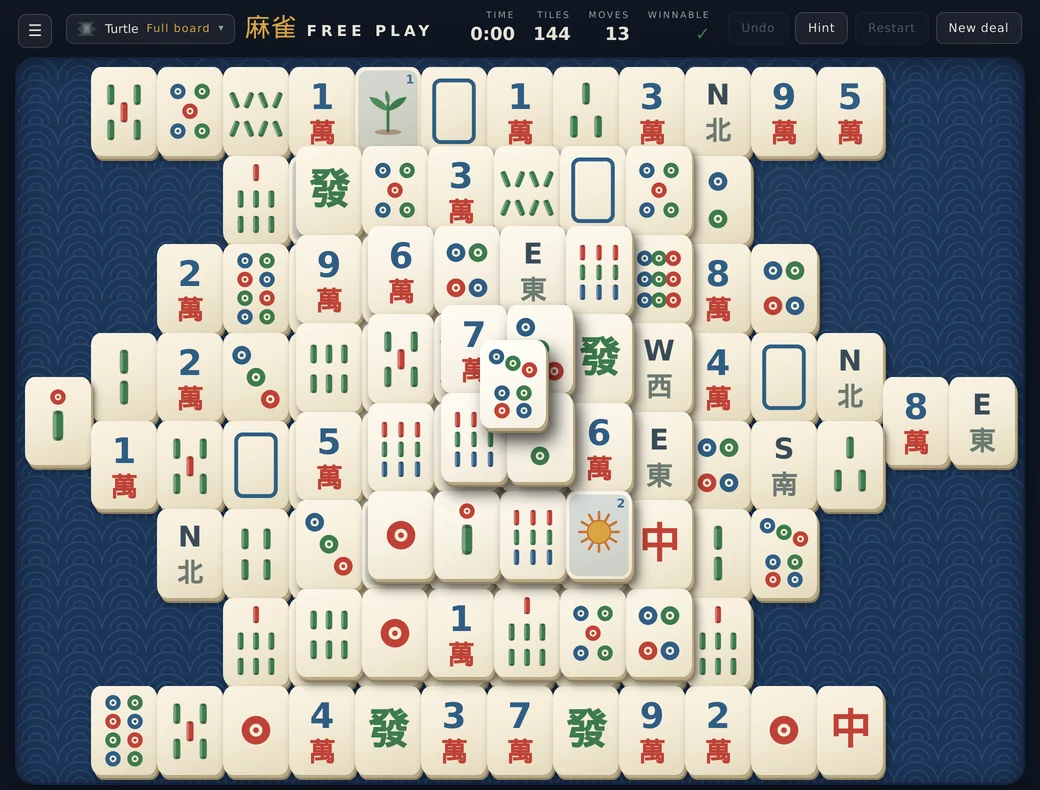
Which tiles can you remove?
You can only remove a tile that is free. A tile is free when it has no tile on top of it and at least one long side (left or right) is open. Tiles buried under others, or wedged between neighbours on both sides, are blocked until you clear what surrounds them.
Matching pairs
Click a free tile, then click its match to remove both. Most tiles match only their identical twin. The exceptions: any of the four flower tiles matches any other flower, and any of the four season tiles matches any other season.
The colour is the tell. Flowers and seasons are the only tiles that do not need an exact twin, and they are also the only two groups drawn in colour rather than in the blue, green and red of the suits - so you can spot a legal pair without reading the picture. This is the one rule that catches people who have never seen a mahjong tile before.
Every face is in the box four times. On a full 144-tile board there are 42 different faces, and 34 of them appear four times over - so most tiles have three possible partners, and a copy buried under a stack is rarely the only one. This is also the reason flowers and seasons match by group: there is only one of each of the eight, so an exact-twin rule would leave them unpairable. (Smaller boards are dealt from part of the set, so they hold fewer copies of fewer faces.)
Removing a pair frees the tiles beneath and beside them, opening up new moves. Clear the whole board to win.
On a touch screen you can also tap both tiles at once with two fingers, and on a computer you can press one tile and release on the other - either way the pair comes off together.
Four ways to play
Daily Art gives everybody the same puzzle at each of four sizes - 36, 72, 108 and 144 tiles - and it changes at midnight. So a day you have ninety seconds and a day you have twenty minutes are both a day you can play. Mondays are gentle and the week gets harder towards Sunday. Clear any size to unlock the day's shared artwork.
Flow is an endless current of compact, changing boards. Clear one Wave and the tide carries you straight to the next, with your place saved whenever you stop. It is our recommended mode for phone play, and it is just as enjoyable on tablets and computers.
The Journey follows the 55 stations of the old Tokaido road from Edo to Kyoto. Each station has three layouts; on the third, the tide recedes to reveal a print by Utagawa Hiroshige. Clear it to add that artwork to your Collection.
Free play is the rest of it: any of the 202 layouts, any size, as many times as you like, with a fresh shuffle whenever you want one. Nothing here is timed unless you ask for the clock, and you can design your own layouts too.
Two things worth being good at
The obvious one is the clock. The other is the chain: take a pair within two and a half seconds of the last one and the chain climbs - x2, x3, and the pop over the board grows and the chime rises with it. Pause longer than that and the chain starts again from one. Your longest chain on a board is kept alongside your best time and shown on the win card and in your personal statistics.
The two pull in different directions, which is the point: the fastest clear is rarely the one where you never stopped to think. Chasing a long chain means committing to pairs you can already see; chasing a time means finding the right ones. A whole board taken in a single unbroken chain earns a badge, and at 144 tiles almost nobody will.
Collecting and keeping track
Every date has one shared piece of public-domain artwork. Clear any Daily Art size that day to keep it as a background you can play on; all four sizes award the same work. Missed Daily Art works join the Tide Plus archive after 30 days. Journey stations and badges unlock their own separate art.
Badges mark the things worth marking: a first clear, a week of dailies, every layout at a size, a board cleared without a single hint. And your stats keep the honest version of your record - boards played and won, best times per layout, a streak, and a calendar of every day you turned up. All of it is stored on your device; sign in and it follows you to another one.
Playing with the keyboard
Mouse and touch are the natural way to play - and if you would rather use the keyboard, the whole game is there too. Arrow keys move between the tiles you can actually play, and Enter or Space picks one up and then its match. U undoes, H asks for a hint, R restarts the board, and N deals a new one in free play. Tab visits only the playable tiles as well, so a screen reader reads out the legal moves instead of all 144 cells.
A little strategy
When several copies of a tile are available, think before you match - pairing the wrong two can bury the tile a future match needs. Free tiles from tall stacks and long rows early, and try not to strand tiles you'll want later.
Honest boards
Every Mahjong Tide board is guaranteed solvable, and we never secretly reshuffle tiles. What locks a board is the order the pairs come off. If you get stuck, it is a real dead end - but there is always a way back.
Stranded means you can still play, but the board can no longer be cleared. The Winnable mark in the top bar turns red the moment a move does it, and Undo then says how many moves it will take back - use it to return to where a win was still possible.
No moves left means nothing on the table matches any more. Same answer: go back, and take a different pair.
More guides: the tiles explained, tips & strategy, and all guides.