Guide
Turtle Mahjong Solitaire
If you picture a mahjong solitaire board, you are almost certainly picturing the Turtle - the humped pile with a long tail, the layout that has shipped with the game since the beginning.
What it is
The Turtle stacks all 144 tiles into five layers: a broad flat body, a raised shell in the middle, a single tile at the crown, and a short tail and head poking out of the sides. It is a friendly shape - plenty of tiles are free from the start, but the buried center rewards planning.
Why it is the classic
The earliest computer versions used this arrangement (it is sometimes just called “the Turtle”), and Activision's Shanghai cemented it in the 1980s. Decades of games copied it, so it became the default mental image of mahjong solitaire. If you have played the game anywhere, you have played the Turtle. (More on that in our short history.)
How to clear it
In this example deal, the highlighted areas are the places to look for useful openings. They are priorities to investigate, not an instruction to remove a pair without checking what it leaves behind.
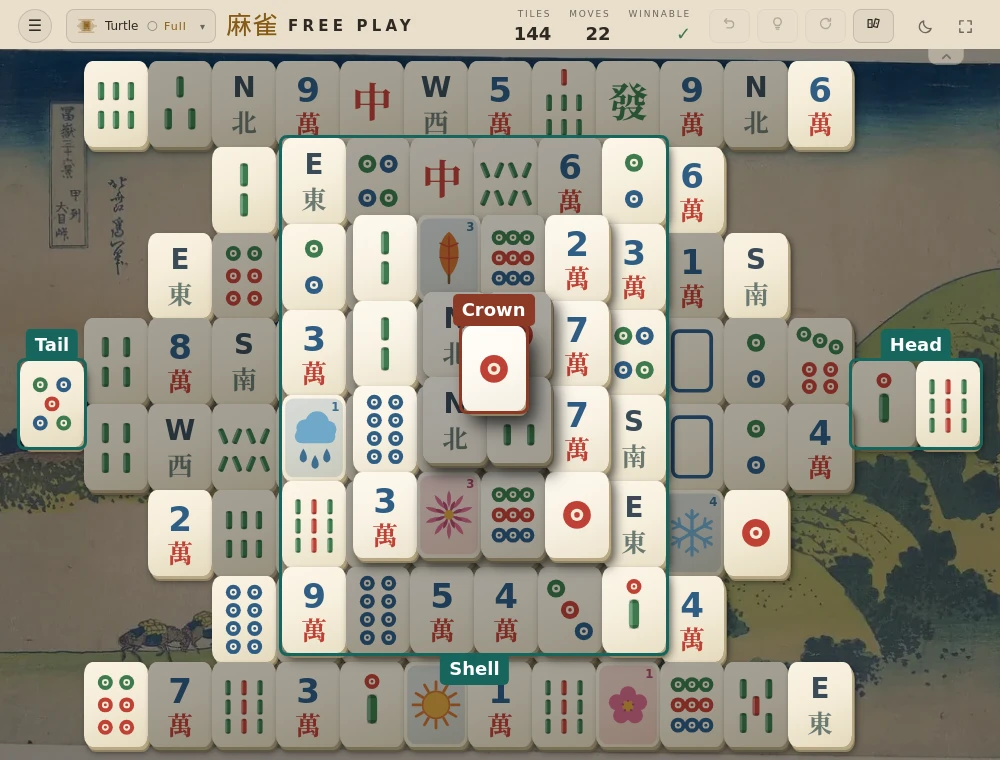
- Open the shell early. The raised center layers bury the most tiles - work into them while you still have lots of free tiles elsewhere.
- Mind the crown. The single top tile covers four tiles beneath it. Removing it exposes those faces and makes the outer tiles of that layer playable; take it when its match is safely available.
- Open the head and tail early. The protruding tiles at both ends block access to the outer rows of the body. Remove them as soon as their matches are safely available to open the Turtle from both sides.
For the general principles, see how to win at mahjong solitaire, and every other shape in our layouts guide.